Monday, 3 June 2019

Whoa, I went off track there

In my recent post, Sorry; you're not who I was expecting, I described that things haven’t recently gone well with my career. I suggested a couple of things contributed to this: over-inflated expectations of myself and brain injury issues. There is of course quite a lot more to say about these. Here I go trying to better explain what I meant…

It isn’t easy finding a job in a new country, no one really knows about the places you’ve worked and the things you’ve done. Add to that a CV made a little unusual by a brain injury and it’s tough to get the start you want.

Yet, my recent history made me think I deserved such a start. I’d recovered from brain injury to complete an Ironman triathlon and a Masters in economics. I’d backed those up by getting two useful, somewhat demanding corporate roles in New Zealand. However, I lacked the experience to demonstrate I’d be much help to London employers, doing the sort of jobs I thought I was capable of.

After mucking around for some time, doing contracting roles, I was lucky to get a permanent position as an analyst, working at a major UK retailer. I started the role, but didn’t appreciate it would be quite different to work I’d done previously. I needed to adjust my approach a whole lot. However, brain injury issues and a lack of insight about myself meant I failed to perform in it. I resigned after it became obvious I wouldn’t pass my probation.

With a very supportive family and partner, I went back to the drawing board. I sought and eventually found a job doing economics, a subject I know I love. I have much more to write about this episode, including the brain injury issues that affected my work at the retailer. I’ve started the new post label, Recovering revisited. Look out for most posts shortly on it.

Cheers,
Mike

Saturday, 11 May 2019

Sorry; you're not who I was expecting (a multi-part post)

Well guys, it’s been over five years since I wrote my last post updating people about my recovery progress. While in many ways I still feel I’m one of the luckiest recoverers around, the last three years of my recovery have been pretty tough. I now realise how I'd thoroughly underestimated how hard it was recovering from brain injury. Quite simply, I wasn't the person I thought I was.

What’s been happening? A lot’s been great: I moved to Britain with my partner I mentioned in my last post, we got married and now have a one year old child. Have things really been that bad you might well ask...

 It took issues with my career to show I was still suffering from some brain injury issues that had been limiting my productivity. Over-inflated expectations of myself meant it took me ages to find a new job in London. I finally found a pretty good one after a bit over a year. However I made a mess of it, brain injury issues contributed to me resigning after only six months in the job.

 I recently got a new job that I feel is a much better place for me. Yet, the brain injury issues I've faced the last three years are still there to deal with. I’ve plenty more to say about them and what my experience says for others recovering from brain injury. In a series of posts, over the next few months, I intend to write much more about them. I intend to explain how I'm not the person I thought I was.

 Hope you stay tuned for what more I have to say. And if you're facing the hardest struggle, recovering from your brain injury, please hang in there. I hope what I have to say will help you, most of all.

Cheers,
Mike

Sunday, 11 August 2013

An update on Mike's recovery

It's been awhile since my last post on this blog - time for an update.  It's now eight and a half years since my TBI.  Although I am still recovering, my life continues apace.  I've taken a demanding new job.  I've moved in with my girlfriend.  I continue to make progress with my running.  Steady as she goes, but with a thumbs up.

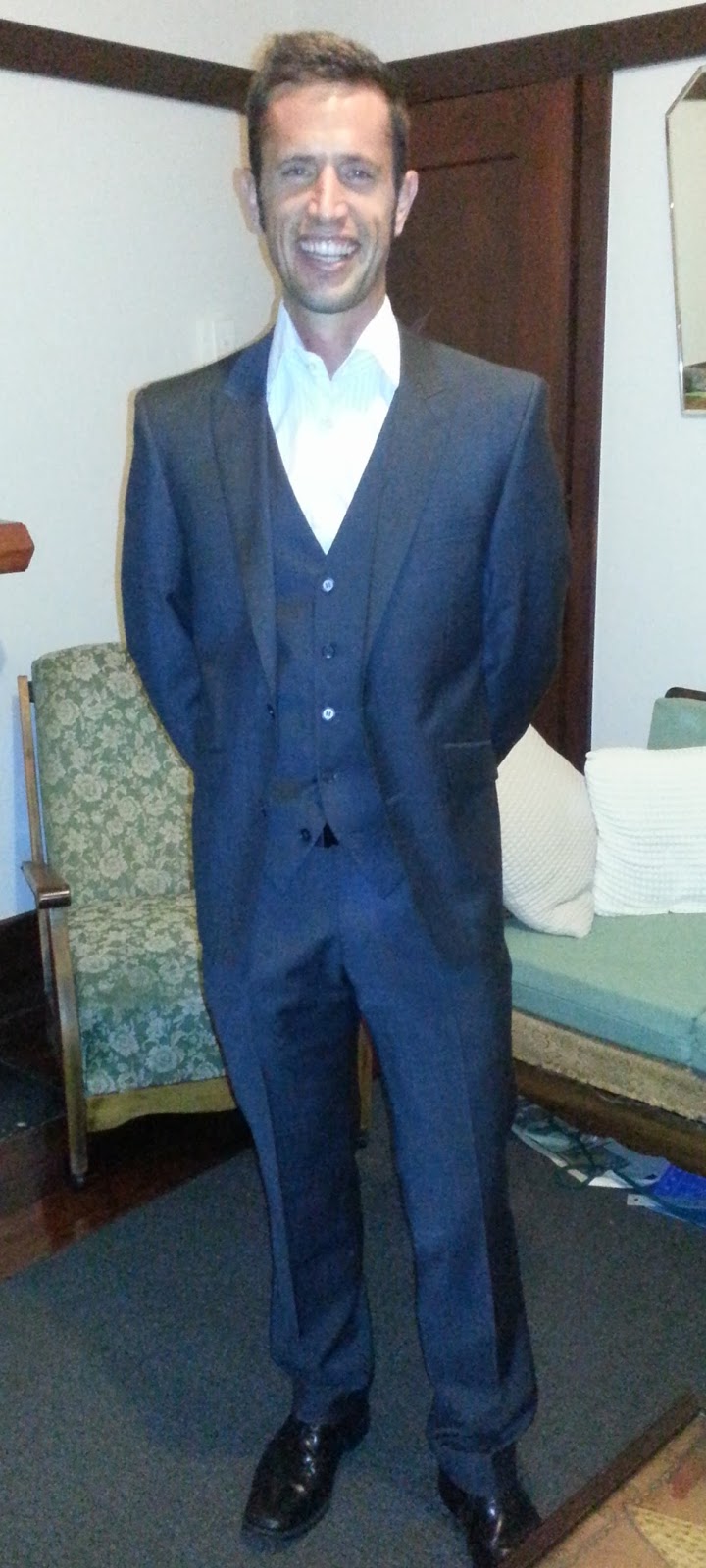
A new suit for my new job!
First of all, my job.  I'm working as a Regulatory Economist for a major NZ telecommunications company.  It's my first job since my accident that feels like proper progress with my career.  As expected, I have to be a bit careful.  For example, I need to take regular breaks during each day.  Still, I am getting the job done.

I've moved in with my partner, a girl I was lucky enough to meet a couple of years back.  She didn't know me before my accident and basically doesn't want to know the specifics of it (although she says I should point out that she's not callous and uncaring).  Could there be anything better at getting me to move on from the debacle that was my accident and its effects?

I was lucky enough to complete that 60k (37.5mi) mountain run that I mentioned in this post.  It was an amazing race to finish, but I won't be doing another ultra-marathon in a hurry.  Now, I've got a new goal, increasing my running speed.  Again, progress has been patchy: my TBI still causes issues with my running.  However, I am slowly getting there, reaching an important milestone, my first 4 min km, just the other week.

As I've explained, I'm by no means free from the effects of my TBI. I am however definitely moving forwards.

Also, I decided to keep this post short, but readers might be interested to hear how I've gotten to this point.  I can only encourage people to read through the posts on this blog.  I think I go through mat of the trials and tribulations I've experienced along the way.  It ain't been pretty, but I'm slowly getting there.

Cheers,
Mike

Monday, 23 April 2012

Friends and TBIs

In comments on this post, I was recently asked how, following my TBI, I got on with the friends I'd had from before it.  I think this is a very understandable issue: TBIs often change the sort of person that we are, it almost stands to reason that we won't get on with our friends like we did, before.  The thing I think's important is accepting that we're different now and that, just as we've changed, our friends might need to change, too.

I myself was raised to only bother hanging out with people who are keen to hang out with me.  If people didn't want to hang out following my TBI (and I'm sure there were some), I just shrugged my shoulders: that was their choice and well, I had better stuff to do, any way.

In terms of meeting new people who might want to hang out with me, I love picking up new sports, joining new teams or trying new activities. Which activities do I try? As I explain in this post, Get into it, I love trying things I reckon I’ll enjoy.

Even with focusing on hanging out with those who wanted to see me, I'm quite sure that I still had much to learn about being a friend.  I've written up some thoughts on that issue here: Talking through people skills.

Cheers,
Mike

Thursday, 15 March 2012

Being Sherlock Holmes

Recently, I've come to realise that what might help many recovering from a TBI is to think of themselves as Sherlock Holmes.  In this blog post, I described the idea that a TBI is like a fingerprint: every one is different!  Other recoverers sometimes asked me if I've experienced an issue they're facing.  Most of the time, I have to admit that I haven't.  However, I still think I can say something useful: recoverers should think of themselves as being Sherlock Holmes.


When I say this, I mean recoverers have to become an expert on deducing what causes or contributes to their issue.  Is it more severe when they're fatigued than when they're feeling rested?  Does it come on after certain activities, like eating particular foods or drinking alcohol?  To recover better, we need to be gurus about ourselves, we need to be Sherlock Holmes.

A part of being Sherlock Holmes and being very familiar with research on the issues we face: read heaps on the Internet or in books (although keep your sceptical mind when doing so); talk through the options with the right people; try different ideas of things we think might help us, just to see if they work.

In this post I wrote last year, I describe one issue I worked out how to deal better with only through a Sherlock Holmes approach.  I worked out how to help my right quad muscle cope with my running by exercising/strengthening my right gluteus maximus.  Learning this only happened through a Sherlock Holmes approach of thinking about it and trying different things until something worked.

Good luck with being Sherlock Holmes.

Cheers,
Mike

Friday, 24 February 2012

How to celebrate my recovery

I think it's very important for recoverers to celebrate the wins from their recoveries: that's another thing that helps keep us going during dark days. There are two things I think are important to the way I celebrate my recovery:

  • some time ago, my brother had the great idea of not doing anything on the 20th February, the anniversary of my accident, but on the 21st, the "anniversary" of my recovery and
  • consistent with my thinking discussed in this 2008 post that the state of my recovery depends on what goals I've achieved, I make special emphasis on celebrating my recovery when I've done something cool.

Earlier this week, I had a special celebration on the evening of the 21st. It was the seventh anniversary of my recovery and, during the last couple of years, I achieved the two big goals I discussed here, completion of my Ironman and my Masters thesis. I went out with my parents for a special meal that night to celebrate.


For some reason, I felt like I had an extra reason to celebrate this year, it felt like I was ruling a line under my recovery. Of course, as I discussed in this post, I firmly believe my recovery will continue from here. However, eventually I think our lives and our recoveries become inseparable. That was what I reckon I was celebrating: I was ruling a line under my recovery by acknowledging that my life and my recovery had become inseparable. I'll continue thinking through this idea so, if I'm confusing you by referring to it, please hold on and look out for my further posts on the subject.

Cheers,
Mike

Saturday, 7 January 2012

To recover or not to recover, that is the question

If you're reading through my musings here and haven't yet picked it up, there is one fundamental thing I hope you take away from this blog.  It is this: as a recoverer, it's your decision to recover or not to recover from your brain injury!

A brain injury can give you a hell of a kicking!  And it will be a kicking the an effect of which others can only guess at.  My TBI certainly did.  This is me, almost seven years ago.


I stayed in roughly that condition for a long time, too.  This photo is taken approximately one month on from my accident.


Yet, do we have it within ourselves to choose to recover?  I cannot talk with confidence about what pulls us through when life hangs in the balance.  Once we're through that stage, though, I hope all of us recoverers believe absolutely, it is our choice to recover.  I've dedicated these last seven years of my life to proving this is so.

Five years on from my accident, I finished an Ironman triathlon, a goal I'd had from well before it.


Last month, I graduated with a Master of Arts from Victoria University of Wellington after writing, having written an 80,000+ word thesis to complete it.


I believe it is up to us to choose to recover.  I hope you will join me in making that choice and that the posts on this blog will help you for it.

Cheers,
Mike

Friday, 9 December 2011

Talking through people skills

I was recently asked by a fellow recoverer if I might write a post about re-developing people skills following a brain injury. Two things make me happy to oblige: I myself am very much a "people person" and I remain committed to helping those recovering from brain injury. What I think will help other recoverees out is talking through people skills in depth with a family member or empathetic therapist.

People skills are of course essential to how we get on life. Yet, they can also require a particular sort of brain power, including a strong sense of other people. For example, there are a whole host of conceivable answers to simple questions like, "What shall we do tonight?" Choosing the best one requires an appreciating not only the context, but also the person asking the question. Following a TBI, it is no surprise if recoverers have trouble with this sort of thing.

What I think's needed to help recoverers re-learn people skills is someone to carefully discuss people issues with. A family member might be the first port of call. However, if a good one of those isn't on hand, I'm very confident that many empathetic therapists would love it if someone asked for the therapist's help to improve their people skills. Talk things over with that person: how social were you before your brain injury, how social do you want to be, now? Talk to them carefully about your experiences socialising, post-brain injury: why did that person say that, why did that person get upset?

In my own case, I am lucky to have a very social mother. She of course understood the way I was before my accident and what sort of person I wanted to be. She merely offered suggestions and encouragement to help me be that person. She did things like encourage me to always ask questions of others and warn me that it's rude to simply walk away from a conversation you've been involved in, but are no longer the central focus of.

I encourage all recoverees to find someone to talk through social issues with. This can be seen as another application of the idea that we need to talk to the right people to recover better.

Cheers,
Mike

Tuesday, 29 November 2011

Dark Days

In some of my posts, such as my last one on mountain running, I fear I might give the impression I'm something of a recovery machine, that I'm an astounding success at recovering from my TBI.  If I have, that impression would certainly not be correct.  I have made mistakes (such as those discussed in Mike's Regrets), but what I think are more important from a day-to-day perspective are dark days,

I think all recoverees, myself included, sometimes face dark days, days where the weight of recovery seems too much to bear.  As an example showing how not to recover, I'm writing this post to talk about what I think helps for dealing with dark days: don't give in to them.

The ability to feel sorry for ourselves is a common human trait.  Whoever we might be, I reckon it's only natural for recoverees, myself included, to sometimes stand back and think, "man, this really sucks!"  A TBI can cause so much stuff to go wrong, there will likely be much to remind us that life is so much more difficult than it was before our brain injury.  It's natural that sometimes all of us will want to pack it all in, to give up and retreat into some deep cave somewhere.

Therein lies the biggest risk posed by dark days.  Do we give in and retreat from them?  That deep cave seems safe from the outside world.  Why not just head in there for a bit of nap?  The thing to remember, though, is that the deep cave provides little shelter from the effects of our TBI, it's actually quite cold and damp.

I think the trick with dark days is know they come, but don't last forever.  As we're experiencing them,  I think it helps to keep in mind that, while not much fun, things could always be worse.  What's important is to stay out of the cold, damp cave, instead standing in the sun as we keep getting into stuff.  Know that dark days come, but don't give into them!

Cheers,
Mike

Tuesday, 15 November 2011

My recovery: it'll be over when I say it's over!

People often ask me something along the lines of, "How long did it take you to recover from your brain injury?"  I usually respond with, "My recovery isn't over yet: I still think I'm recovering now."  The natural follow up question is, when will your recovery be over?  Back in 2008, I wrote a verbose post on this blog, How Long Does TBI Recovery Take?  In it, I talked about the length of my recovery depending on what goals I set myself.  One activity recently reminded me of the concept, though: my running.


Running in the hills above Wellington city, New Zealand.

Using my running as an example, I want to explain my new answer to the question of when my recovery will be over: it'll be over when I say it's over!

I had my accident shortly before I was to reach my goal of racing Ironman triathlon in 2005.  Being a goal-focused person, I was desperate to build back up to it.  As I started running again, I quickly realised how physiologically complex the activity is to do.  Gradually, I relearnt how to control my muscles well enough, particularly those in my core, to run properly.  Eventually, I was running well enough to support my finally completing Ironman in March 2010.

Even through Ironman, though, I carried a number of running issues.  A key one was that my right quad muscle group would seem to run out of push after about 20-30 mins of running.  The issue wasn't bad enough to stop me doing Ironman: If I walked ten paces, it would come right and I could start running again.  However, I love my running and it was hindering my enjoyment of it.  Once I'd finished Ironman, I was keen to get it sorted out.

In the second half of last year, I restarted my recovery process: I saw physios, tried new things like yoga classes, stretching and muscle exercises and talked to lots of relevant people.  After about six months of trying stuff, I made a breakthough: I realised it wasn't my right quad muscles I needed to worry about, it was my right gluteus maximus (as well as another muscle close by, the gluteus medius).  For some reason, exercising those two made a big difference to my issue with my quad.  Although they haven't solved it completely, just yet, I think they'll allow me to run well enough to train for and complete off-road running events (as per my photo).  (Off-road running seems easier on my quad muscle issue.)

Since I built myself up for Ironman (twice!), you may be thinking I'm someone who likes big goals.  You'd be right!  In New Zealand, one big goal involving off-road running is the 60k (37.5mi) Kepler Challenge, following the Kepler Track in the South Island.  Guess what I'm aiming to be next November?  ;-)

Herein lies my idea.  There are things like running that I really want to enjoy.  It is up to me to do all I can to recover for them.  No matter how long it's been since my brain injury, my recovery will only ever end when I decide to stop working out how to recover more.  It'll only be over when I say it's over!

Cheers,
Mike

Sunday, 16 October 2011

From theorising in my brain to theorising in my thesis!

I mentioned in an update in my last post that I had completed my Masters thesis.  I decided readers might well want to know more about how I found it so I've pulled together this post.


Me with the result of 21 months' work: a 300-page bound book.

The main word for how I found it: big!  My thesis started out as a simple question: what made New Zealanders use their debit card payment system, EFTPOS, so much more than Australians or the citizens of other countries used theirs?  Before my brain injury got in the way of things, I'd often pondered doing postgraduate study in economics.  Suddenly, I had an interesting research question to study.  Once this simple idea had germinated, however, it seemed nothing could stop it.  I found an economics professor in my hometown or Wellington willing to supervise my completing a Master of Arts By Thesis.  My thesis eventually became an 80,000+ word study of the economics of the development of retail payment systems in seven Western countries.

Although I started with the plan of finishing the thesis in only one year, it took me 21 months to put it to bed.  I was however very happy with the finished product.  (If you're really interested, the full thing can be downloaded from my university's research archive here, although I summarised it substantially in the context of New Zealand in this guest post for the NZ political blog, Kiwiblog.)  What was the greatest issue for getting my injured brain through thesis writing?  Well, it seems there were two: theorising about my idea in my brain and getting that theorising written down in my thesis.

In terms of theorising in my brain, some major things guided me forward.  When I think back over them now, they're remarkably consistent with ideas I've written about for TBI recovery.  I found it very useful simply to keep talking to the right people about my thesis and where I felt it was heading.  I also thought it important that I enjoyed myself, writing my thesis, and simply keep the faith that I would figure it out.  Did my brain injury slow me down as I thought my way through my work?  I think that's more than likely, but I was enjoying myself so don't feel like that mattered at all.  I just hung in there believing I would find the right way of thinking through my thesis.

As I had figured out parts of my work in my head, the next trick was writing them up in my thesis.  Once again, several things helped me considerably.  The two ideas listed above once more came in handy.  The art of writing well is not a simple one, however.  I think it helped me substantially to have practiced my writing on various blogs around, including on this one.  This is yet another thing that I think has parallels in brain injury recovery, which I outlined in this post, Get Into It!

Even before my brain injury, I think my thesis would have been a major bit of work.  How did I feel about trying to do it with a brain that didn't operate as well as it once did?  I just shrug my shoulders and think, oh well, at least I was still around to do it.  My brain injury could have been so much worse!

If you are a recoveree considering doing something big, I wholeheartedly encourage you to get stuck in and have a crack at it!  See your brain injury not as some insurmoutable obstacle, but as merely something to be managed.  Go for it!

Cheers,
Mike

Wednesday, 5 October 2011

Embarrassing stuff following a TBI: Google it!

(Please forgive the delay, but it's been a long while since I last posted.  I've been thinking about this post for some time, but haven't focused sufficiently to pull it together until now.  I regret that I've rather been distracted by a frustrating job search following my successful completion of my Masters thesis earlier this year.)

The brain seamlessly controls many, many things.  When we damage it, weird things can start to happen.  And we might not be comfortable talking about some of them.  They may in fact be down right embarrassing!  All is not lost, though.  There is one source of information that won't ask any questions about why you're researching stuff: Google!

Two embarrassing things have arisen during my recovery.  One of them I'm happy to talk about, but the other rates barely a mention.  That's because I remain too embarrassed to discuss it in such a public way.  (I'll leave you to guess from the first how I dealt/am dealing with the second!)  The first is that I (still!) have problems recognising people's faces and the second, that I have occasionally had problems with bladder control.

I am by nature a social person: being around friends and family matters hugely to me.  I find it very natural to be friendly with everyone, it feels energising to me.  I have absolutely no wish to be seen as unfriendly towards people.  Yet, an important part of being friendly is recognising people when you see them again.  If I've only met someone once or twice, though, this is the part I battle with: no matter how involved the conversation was, if I've only met someone the once, it's reasonably likely that I'll completely fail to remember who they are when I see them again.  (This issue is much more than just forgetting people's names, which I wrote a bit about here!)

For some, this might not be a major issue, but for me it definitely is.  Yet, how can I explain it to someone?  Even if I was comfortable with doing so, there would be only a very small number of specialists familiar with it in a small country like New Zealand.  I imagine many neurologists or brain injury specialists would look at it and say, show me a real problem.  To me, though, this is a real problem!

Google's not going to be worried about the seriousness of my problem.  If I input the keywords, brain problem recognising people, if faithfully reveals that I in fact have a condition called prosopagnosia.  Further searching reveals sites such as this one that say there is no formal treatment for the condition.  Sounds to me like an invitation for me to be determined to recover and think hard about how I might work around it.  When I meet someone, can I try remembering their hair colour and the facial features so I can remember them if I meet them again out of context?  With careful thought and a bit of research, surely it's up to me to work out how to recover!

Cheers,
Mike

Friday, 29 October 2010

TBI Recovery and a Higher Power

Recently, I’ve had many chats with a close friend recovering from a compulsive disorder.  While I won’t claim to understand everything he talks about, I am more than happy to chat through things with him and hope that my thoughts are in some way helpful.  Among the things I myself take from all our discussions are the parallels between recovery from his disorder and TBI recovery.

A major part of recovery for my friend is accepting a higher power can help us recover, but also learning to give up control to that power.  (Recovering alcoholics may know these as Steps Two and Three of the Twelve Steps of Alcoholics Anonymous.)  This may seem difficult to believe, but recoverers from compulsive disorders experience more control over their compulsions by wilfully giving up on having control!  That idea’s not a simple one –I think it took me some proper thinking to even start to get it – but please bear with me while I talk through what I think it shows for TBI recovery.

With this idea in mind, I thought through my TBI recovery and realised I’d touched on it in my post, Having Faith I Will Figure It Out.  In the post, I describe how I keep myself going by having faith that, sooner or later, I’ll work out a way of solving, or at least of significantly reducing, any problem I run into.  Sometimes I think me working it out comes from getting a sign – in the post, Listening to Your Body: Sweating and Cravings for Salt, I wrote about how I (eventually) realised one sign: my body was showing it was lacking salt by giving me cravings for salty foods.  Maybe my giving it up to a higher power is accepting that, whatever issue comes along, I’ll be given a sign about how best to deal with it.

On the question of fatalism versus freewill, I fall very much on the side of free-will: while I believe a greater power might give me a sign as to the right way, I believe it is entirely up to me to follow it.  Please let me know if you agree or have any thoughts about my attempting to reconcile fatalism and freewill for TBI recovery.

Furthermore, this is not a simple subject: like I said, I still think I’m figuring it out.  I also think it’s critical to the daily decisions we make in our recoveries.  Please feel free to comment on here if you any further questions on it.  If you’re wondering about something, no doubt others are, too.

Cheers,
Mike

Another Update on Mike's Recovery

Hi guys,

It’s been a while since I last posted, but, after a pretty busy first half of this year, I’ve recently decided to ease back a bit and live a more balanced life.  As part of doing that, I promised myself I’d restart writing posts for this blog.

As an update, things are well here.  As you may have seen from my previous posts, I completed the first of two major goals for this year back in March: racing the Ironman New Zealand triathlon.  I had hoped to be finished with the second goal, completing a Masters thesis in Economics at a New Zealand university, around the middle of this year.  Regretfully, my progress towards that goal hasn’t been quite as smooth and I now hope to have it (nearly) all done by the end of this year.

As I said and in spite of still having a bit to do, more balance in my life means more writing for this blog.  First up, is my post, TBI Recovery and a Higher Power.

Cheers,
Mike

Sunday, 18 April 2010

Media Coverage of My Story

Of course, with my accident, recovery and build-up to Ironman, there's been some media coverage of my story. That culminated in the week of Ironman with a story about me being aired by the New Zealand current affairs television programme, Campbell Live.

The story's available on Campbell Live's website here (regretfully, I'm unable to embed the video).  I think it may be most interesting to my readers because it contains a whole series of videos of me shortly after my accident.  Be warned, I'm not in a good way in those.  Fortunately, though, I've improved since then and firmly believe, it's the comeback that counts! :-)

(With Ironman now over and out of the way, I'm enjoying the return to the quiet life and not having nearly so much fuss around me!)

Cheers,
Mike

Finally Running Home an Ironman!

During a quiet training ride, just two weeks before I was to race Ironman New Zealand 2005, I had a spot of bad luck: I was involved in what should have been a minor traffic accident.  Because I was on a bike, however, it was anything but.  I suffered a severe traumatic brain injury and missed my race, what would have been my first Ironman, because I was still in hospital in a coma!  I lost my health, I lost my career, I almost lost my life!  Through all of it, though, I never lost my desire to race an Ironman, slowly but steadily rebuilding my strength, fitness and abilities.


On March the 6th this year, five years after I should have, I finally ran home an Ironman!


(This is my favourite photo from Ironman because, while it shows me running towards the finish, it doesn't actually show me crossing it, as if my race isn't over.  I like it because, as I explain below, I don't feel like "my race" is over yet!)

For me, Ironman (which involves a 3.8k swim, 180k cycle and then a 42k run) wasn't what I'd expected at the start of the day.  I had a good swim...

(A shot of the mass start involving over a thousand swimmers - I'm in there somewhere)

... and a reasonable bike ride... 

(looking settled)

... only to have problems on the run!

(feeling the pain!  That is a frown, or as much of one as I can manage!)

Unfortunately, I became quite ill about a quarter of the way through the run.  However, after the saga that's been my build-up to Ironman, I wasn't going to let a bad stomach get in the way of finishing.  Things gradually improved, particularly when four supporters came off the sidelines and starting running with me.  Gradually, my running style came back together and I truly enjoyed the final stages of the race, running home in a time of 12.54.

(me with my fantastic support crew afterwards!)

How does it feel to have finally completed my goal and raced an Ironman?  In a word, fantastic!  Ironman has been such a saga these last five years; although my race wasn't the best, I feel like I've been released, like I can now go on to other things.  And there are indeed other things!  Of course, finishing my 50,000 word Masters thesis is currently my biggest goal, but really there's a whole bunch of things I want to improve at.  My recovery - my race - isn't over yet!

I remain committed to the process of recovering.  Ironman was only a step along the way and I hope for all the best in furthering recovering.  I wish other recoverers out there well and hope I hear stories of things other people have gone on to do, following their brain injury.

Cheers,
Mike 

Friday, 18 September 2009

An Update on Mike's Recovery

It's about time I wrote an update on how my recovery's going. As readers may have noticed, I've had little time recently to write posts for this blog. That's because my recovery's all go! Right now, there are two major parts to it and it's these I want to fill readers in on.

The first part is my second attempt at racing the Ironman triathlon in Taupo, New Zealand in March 2010. Readers may have seen in other posts that I received my brain injury in a traffic accident I had while training two weeks before the same race in 2005. An intense desire to race Ironman is something that's always been a special motivation for me to recover more. I'm really looking forward to finally achieving this goal.

The second part is a Masters degree I recently started in my favourite subject, economics, at a university here in Wellington, New Zealand. The degree involves the preparation of a 30-40,000 word thesis, which I am hoping to complete about June next year.

I continue to think about brain injury recovery and what readers might like to hear about my experiences as I attempt to complete these two goals. Unfortunately, finding time to write them up and put them on here is a bit of an issue, right now. But readers can rest assured that I'll get them up here at some stage soon(ish).

Cheers,
Mike

Sunday, 9 August 2009

What Did My TBI Feel Like? Cloudy!

My Dad recently reminded me of the way I described my TBI not long after I received it! For me, my TBI basically made me feel all cloudy. I'm lying there in a bed in my rehab centre; I'm not in pain, but I'm just trying to take it all in. Yet things are so confusing and my head just feels unable to cut through that confusion.

Of course, I've just been thrown into this new environment. I've got very new limitations - I can't walk, I can't even talk properly - and I've now got a very unfamiliar outlook on where my life's heading. What will my recovery be like? It stands to reason that I'm going to be confused, but my brain just can't seem to get started on making head or tail of it! I find myself in this surreal world where I just can't find my bearings.

Fortunately, things do start to fall into place. They slowly begin to make sense and you get more certainty about where things are headed. The cloud lifts.

Getting clarity on where things were at was the start of looking at/thinking about what needed to be done. So it feels more like I should finish this post by saying, the cloud's lifted, let the Games begin!

Cheers,
Mike

The TBI Fingerprint

My own experiences with brain injury recently led my Mum into joining the Committee of the local brain injury association. One of the other Committee members discussed a good analogy for brain injuries and I thought I'd blog about it here.

The Committee member's analogy was, every brain injury is like a fingerprint. There's stuff in common with other brain injuries, but it's pretty much unique! No two brain injuries will be alike.

That idea might create issues for my readers. If every brain injury's unique, why should I bother reading about recovery ideas from a bloke who's only had one of them? After all, my fingerprint will be different to his.

Another thing is, it might make recoverers feel better or worse that their brain injury was more or less severe than someone else's. However, in Recovery from Any TBI, I say how I think, in terms of effects, there's little that sets any TBI apart. If I meet anyone with a TBI, I can be fairly confident that it's fundamentally changed their life. Every TBI's unique, but that doesn't take away from the effect of any one TBI.

What might be similar between recoverers, though, is attitude! Accordingly, the main goal I have when I blog is to help other recoverers find their own determination to recover!

Cheers,
Mike

Thursday, 30 July 2009

Listening to Your Body: Sweating and Cravings for Salt

Your body is exceptional at telling you what it needs. All you have to do is listen!

One particularly undesirable effect of my brain injury is, when I exercise, I sweat... heaps. As long as I drink lots of liquid, I have no problem with it (although I'm less keen on running into girls I want to impress when I'm like that :-). However, I'm only slowly getting used to the new ways my body operates.

As I started triathlon training more regularly, I was exercising more often and therefore sweating more. About the same time, I started experiencing periods of cravings for potato chips. I'd never before had intense desires for particular foods (both before and since my accident), so I was very perplexed by such episodes.

Eventually, I realised that what my body was after was potato chips for their salt to replace the amount of salt I was losing in my sweat. Eureka! I increased the amount of salt in my diet by adding it to meals every so often. I haven't since experienced trouble with cravings for chips.

I certainly don't propose every recoverer will have a similar craving caused by sweating more! What I am saying is, listen to, and think hard about, what your body's saying to you. A TBI will likely change some/many of the ways your body works. As you get used to the new you, it might help to pass close attention to what it's trying to tell you.

Cheers,
Mike